Marketing teams are giving AI more authority over campaigns, while providing CRM data they know isn’t ready for the job.
According to Validity’s “State of CRM Data Report 2026,” nearly 91% of marketers say data availability is critical to AI adoption, but only 21% consider their CRM data very well prepared for the AI tools they use or plan to use. Meanwhile, 45% already use agent AI that can act without human review, and two-thirds of organizations have increased the number of marketing decisions delegated to autonomous agents in the past year.
Bad CRM data once meant manual cleansing and inaccurate reporting. Now an AI agent can automatically act on these errors, sending a campaign, obtaining a lead, personalizing an offer or reallocating the budget before anyone reviews the decision.
Marketers know the data isn’t ready
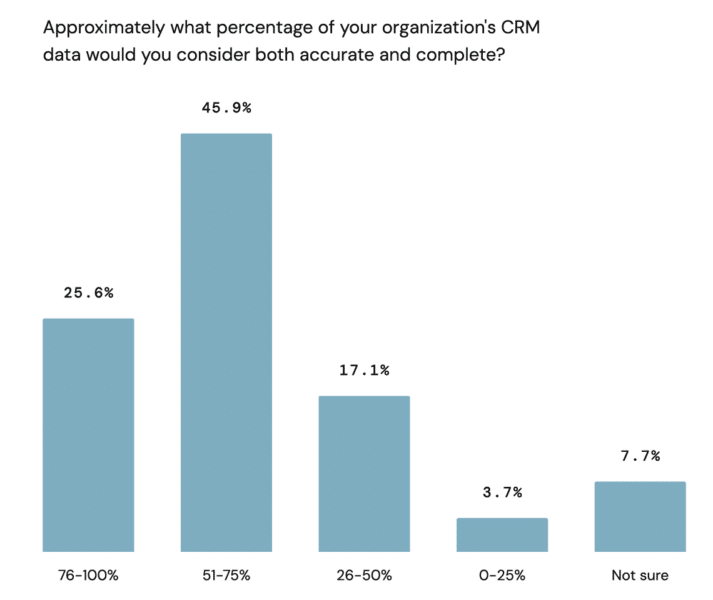
Only 26% of respondents said that more than three-quarters of their CRM data is accurate and complete. Nearly half said their organization struggles with CRM data quality.
The consequences are already reaching the revenue. 62% said poor CRM data probably or definitely costs their organizations through issues such as missed renewals, inaccurate forecasts, lost deals and misdirected campaigns.
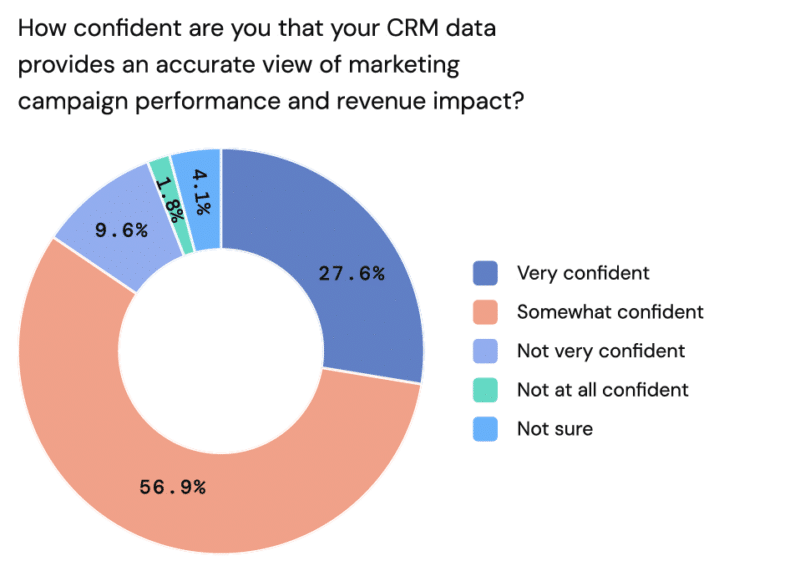
At the same time, only 28% are very confident that their CRM provides an accurate view of campaign performance and revenue impact. Organizations believe that bad data costs them money, but they have limited confidence in the data they use to determine how much.
This uncertainty follows the numbers in meetings. Nearly 69% said a revenue, pipeline, or performance figure they or their team submitted was disputed or retracted because the underlying data was incorrect. Among senior executives, SVPs/VPs, department heads and directors, the percentage rises to nearly 75%.
Better attribution and reporting can’t solve this problem if underlying customer, campaign and revenue data remains questionable.
Artificial intelligence turns data errors into marketing decisions
The consequences of unreliable CRM data become more severe as AI makes more decisions. About 19% of respondents said they had often made or acted on an AI-generated recommendation that they later suspected was wrong due to a lack of underlying data. Another 43% said this happens occasionally.

The numbers increase significantly with seniority. Nearly 78% of senior executives and 92% of SVPs/VPs said they acted on an AI recommendation that they later suspected was wrong, compared to 41% of individual contributors.
10x your SEO with Semrush for business.
The most powerful SEO platform in the world, created specifically for businesses.
Request a demonstration
The readiness gap also has an organizational component.
Only 39% of C-level executives, SVPs/VPs, department heads and directors said marketing and IT or RevOps work very well together to keep data actionable for campaigns. Among senior executives and individual contributors, the percentage drops to 27%.
The property is equally unstable. Only 41% said their organization has a team or owner dedicated to data governance. Respondents also cited poor alignment between marketing, sales and RevOps and a lack of clear internal ownership as barriers that prevent CRM data from reliably supporting marketing.
The result is an uncomfortable combination: more automated decisions, questionable underlying data, and the responsibility of keeping that data spread across teams.
Fixing the readiness gap
When asked what would most increase trust in CRM data for strategy, reporting and AI, 39% chose continuous automated monitoring that detects and resolves issues in real time. A unified platform came in second place, followed by third-party data validation or enrichment.

Validity’s “State of CRM Data Report 2026” surveyed 500 B2B and B2C marketers in July 2026 at organizations with at least 100 employees. Respondents came from the United States, United Kingdom, Brazil, Australia and New Zealand. Can be downloaded here. (Registration required)