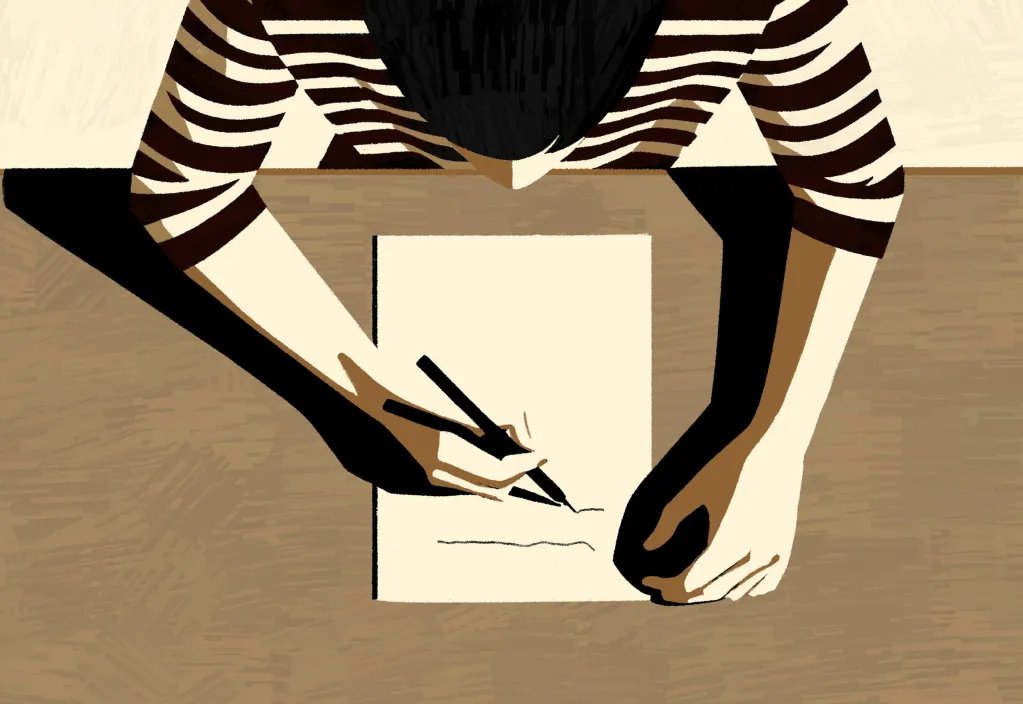

I remember the first time I walked into a writing workshop in prison. The dark room contained barely more than a dozen mismatched plastic chairs and a few misshapen tables. Before enrolling, I had struggled with lingering melancholy after two years in county jail that resulted in a life sentence.
My depression threatened to drag me deeper into an abyss. During those dark times in the past, I had self-medicated with alcohol and drugs. But sitting among my peers, listening to their writing, I was strengthened.
My day of enlightenment came when a woman in our writing class shared a story so raw and vulnerable that I had to dig my nails into my palms to keep the tears from streaming down my face. That self-inflicted pain, which left half-moons in the depths of my palms, dissolved when I looked up. She had a fragile smile on her face. She exhaled and smiled wider, as if she had dropped a heavy load.
It reminded me of what Maya Angelou said: “There is no greater agony than carrying within you an untold story.” »
Writing became a refuge, my mind an incubator of ideas. Thanks to the patience and dedicated care of the writing workshop teachers, a flood of words filled one notebook after another. I found intimacy in writing, in knowing myself in relation to the world around me.
If I’m honest, my goal has always been intimacy.
First with books, when my parents were too preoccupied to notice my withdrawal; later with men. While my poor choices led to a diminished sense of self-worth—and ultimately prison—writing restored a sense of agency in my life.
Related: Math Can Be a Path to Success After Prison
My interest in writing predated my incarceration, but years of trauma, both physical and psychological, had stifled its growth. The writing workshops reignited my passion for learning and deepened my commitment to healing. Writing workshops provide a vital educational opportunity for people who are effectively excluded from traditional college programs. Florida’s prison system houses more than 80,000 women and men, but only a few hundred men and fewer than 30 women are enrolled in a degree program.
Here at Homestead Correctional Institution for Women in South Florida, demonstrating their thirst for education and personal development, more than 100 women enroll each semester in at least one college-level course, led by Exchange for changea non-profit organization based in Miami. Courses include, among others, fiction, journalism and theater, in English and Spanish. Some participants earn continuing education credits from Florida International University.
In a Writing as Social Action class taught by FIU Professor Tania Lopez, our discussions examined both individual and collective responsibility. The program included zines created by a young woman who, as a teenager, experienced homelessness and food insecurity. Reading her story, I felt a kinship that I was loath to name: homelessness.
I ran away from home several times between the ages of 11 and 14, until my parents gave up and let me go.
For the next seven years, I was homeless on and off. I dressed up my life situation in opaque terms. “I’m between places,” I told my mother from an extended-stay hotel room in Tampa. “My boyfriend and I are estranged,” I told a friend when I showed up at her door with a suitcase. After a car accident left me with a broken pelvis and I could no longer pay the rent, I crashed at a friend’s house.
Because I have never spent a night on the streets, I was unable to name what became obvious as I read the painful words on the zine’s artfully decorated pages. I was homeless. I had been living without stable housing since I left my family.
Writing the word homeless during class changed something in me. A crack appeared in my foundation. When Professor Lopez asked me if anyone wanted to read, I was too ashamed to raise my hand.
Writing has a way of bringing ugly memories to the surface, like weeds in a well-tended garden. But naming something matters. I was homeless. It is from this pain point that the author of the zine chose to act, advocating for affordable housing, housing cooperatives and rent control.
For our capstone project, Professor Lopez challenged us to identify a community need and think about how we might address it. I looked at the women sitting next to me and knew that many of them had suffered violence and betrayal before being incarcerated.
I began to outline my vision for an online literary journal dedicated to women affected by gender-based violence. My hope is simple: that more women discover the strength that writing has given me.
I write because I carry an untold story, shared by countless women who have survived violence at the hands of those they once loved. Writing became my lifeline and my mission: to foster trauma-informed expression and give shape to experiences too often ignored.
My assignment maintaining the prison grounds recently brought me an unexpected revelation: As I swatted away mosquitoes and handled the pruning shears, I was reminded that removing something old and useless creates an opportunity for growth and renewal.
Paula Grieve won a 2024 PEN America Prison and Justice Writing Award and a 2025 Stillwater Journalism Award and has had her writing featured in Oakland Arts Review, Sinking City Magazine, and Literary Hub, among others. She studies business at Adams State University in Colorado.
Contact the opinion editor at opinion@hechingerreport.org.
This story about writing workshops in prison was produced by The Hechinger reportan independent, nonprofit news organization focused on inequality and innovation in education. Register with Hechinger weekly newsletter.
The article OPINION: In a prison writing workshop, I found refuge and a path to understanding the “untold stories” inside us appeared first on The Hechinger Report.