
Personalization is quite good at guessing what customers might want. It’s much worse to make them feel like the brand knows who they are.
This is the problem lurking in many otherwise respectable customization programs. In research from SheerID and Censuswide, 55% of consumers said tailored offers are helpful, but only 36% said such offers often recognize something meaningful about them, such as their job, life stage or community. Nearly three in 10 say personalized offers feel intrusive, and a similar share say they are based on inaccurate assumptions.

So yes, the recommendation engine might know that you looked at a laptop. He might even know that you’ve watched three of them. What you may not know is that you are a student, a healthcare professional, a new parent, or someone who has been purchasing from the brand for 12 years.
This difference is where customization starts to get interesting.
Relevance only gets you so far
Marketers have spent years getting better at inference. Browsing history, purchasing behavior, campaign response, and modeled intent can help make an offer seem relevant at that moment.
Consumers don’t want all this to be thrown away. Thirty percent said they preferred a mix of inferred and consensus-based attributes, while 28% preferred inference-only and 26% preferred consensus-based attributes only.

So the task is not to stop guessing. It helps you know when guessing is enough and when you should ask.
A customer browsing on laptops can see more content on the laptop. Well. A customer who tells you they are a student gives you something more useful: a fact that can change the offer, message or experience without forcing the system to infer it.
The real friction is asking for the wrong thing
Consumers will share more when the exchange makes sense.
The strongest motivators were one-time savings, loyalty points or rewards, saving on future purchases, and access or free trials. Only 10% believe that exclusivity in itself is enough.
The most interesting part is what drives people away.
43% said they would abandon the verification if they were asked for sensitive personal information, and 38% said they would abandon if they were asked for more information than expected. Only 12% blamed too many steps, and 11% said the process was too long and would force them to abandon.

So much for obsessing over whether the form has four or six fields.
The biggest problem is surprise.
57% said they want to know the benefits before starting, while 45% want to know how their data will be used.
If the customer can’t understand why you’re asking or what they’re getting in return, taking a few seconds out of the flow probably won’t save them.
More data can worsen the experience
Comfort decreases rapidly as the information becomes more sensitive.
Most respondents felt comfortable sharing an email address, name, or age range. Far fewer felt comfortable sharing an employer or membership organization, an official document, an identification number, a social security number or a national identification number.
This gives marketing operations teams a useful rule of thumb: If the answer won’t materially change the experience, why do you ask?
The location where the request occurs is also important.
67% said they would prefer to confirm eligibility on the brand’s site or app, while only 11% would prefer to be redirected to a third party.
A redirect gives the customer another thing to wonder about. Who has my data now? Why did I leave the site? Am I still dealing with the same company?
None of these questions help conversion.
Recognition becomes more valuable after the first purchase
The research found that 62% said the recognition would make them more likely to purchase, and the same percentage said they would be more likely to choose the brand again. 56% said they would purchase more often and 56% said they would be more likely to recommend the brand.
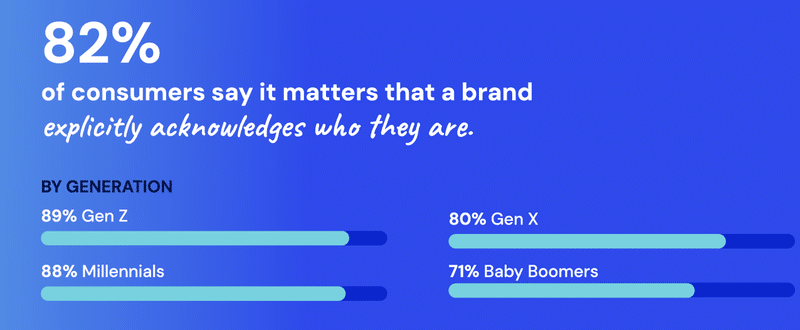
These are the stated intentions of vendor-sponsored research, so keep it in perspective.
The most useful finding is what people say makes them feel recognized over time.
61% chose automatic loyalty rewards. 33% appreciate brands that remember their preferences and history. 23% like not receiving promotions for things they don’t buy.
The latter deserves more attention than it normally receives.
Personalization teams spend a lot of time deciding what to send. Sometimes knowing what not to send is the best signal.
The full report can be downloaded here. (No registration required)
The post Personalization Knows What Customers Want, Not Who They Are appeared first on MarTech.