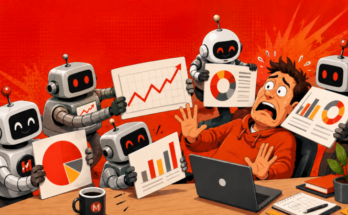
You bought the best AI tools with the expectation of faster delivery, but nothing has really changed. Marketing campaigns still take weeks, if not months, to execute. If this sounds familiar, you don’t have a technology problem: you have an operating model problem.
Over the past 10 to 15 years, marketing departments have worked on agility to keep up with the pace of digital technology, and some companies have adapted very well, while others have resisted agility or failed to rise above surface-level ceremonies.
Fast forward to 2026, agility will no longer be an optional way of working. Artificial intelligence has amplified the speed from a commuter train to a high-speed train, and agile, mature companies are positioned to take advantage of the benefits enabled by this new wave of technology.
Organizations adept at agile marketing have a built-in advantage in adopting AI because they already possess the organizational muscles that AI requires: experimentation, feedback, adaptability, collaboration, and decentralized decision making.
Success with AI starts with organizational preparation
AI gives your team the ability to launch marketing initiatives in minutes, but most organizations aren’t equipped to handle rapid execution. Implementing AI is the easy part: changing the way people work can take much longer.
10x your SEO with Semrush for business.
The most powerful SEO platform in the world, created specifically for businesses.
Request a demonstration
Marketers need to shift the conversation from “What AI tools should we buy?” to “Is our organization equipped to use them?” Without adaptable, self-organizing teams, AI projects could sit on the shelf for months.
So how do you know if your organization is agile enough to succeed with AI? Ask yourself honestly how many of these apply to your marketing organization:
- Slow approval processes.
- Functional silos.
- Strict annual planning.
- Fear of experimentation or failure.
- Limited autonomy at team level.
- Difficulty in modifying established workflows.
- Technology decisions disconnected from actual marketing work.
If you answered yes to any of these questions, your organization needs to improve its agility to reap the benefits of AI investments.
Agile teams already think like AI adopters
Mature agile teams are used to testing rather than predicting, working iteratively, learning from experimentation and data, and making decisions on their own. That’s why two marketing organizations using essentially the same AI technology can achieve dramatically different results. Here is the story of two drastically different operating models:
Harry’s Hats is an online retailer that has recently invested heavily in an AI-powered tool stack. It is a small, agile organization that works in product-focused teams and runs weekly campaigns.
The marketing group is made up of three teams representing different product lines, each consisting of a product marketer, a designer, a copywriter, a developer, and a marketing coordinator. Each team has clearly defined goals, a clear prioritization system, and autonomy to create and deliver campaigns within the team.
When they implemented new AI technology, they immediately improved delivery speed while maintaining quality. They now run five or six marketing campaigns a week with the same number of team members.
In contrast, Insomnia Insurance, a large regulated company, has adopted the same AI tools. However, the company is organized very differently and has achieved very different results.
The insurance company has a marketing team of the same size, but it is organized into functional silos. The copywriter must hand off the work to the graphic design team and wait in line until his work is in the queue. This can take several weeks.
Since almost every initiative requires a software developer, this wait can be even longer as the team is overloaded with work requests. Once a marketing campaign passes through each department, it must go through three or four rounds of review, several weeks after the process begins. If one of the reviewers is on vacation, the work remains inactive.
The company can provide marketing work in minutes. However, its outdated operating model and bureaucratic ways of working mean that projects take months to get to market, which is too slow for the pace of today’s high-speed rail.
What marketing leaders can do now
If your business is more like Insomnia Insurance, it’s time to take action. With just a few targeted moves, you can add agility to your organization and improve your ability to get real results from AI investments.
Start with workflows, not tools
It’s easy to get sucked into the hottest new AI tool, but instead of thinking about what it can do for you, start by identifying marketing workflows where AI could make work easier, remove friction, or improve decisions.
Remove unnecessary approvals
Determine what decisions teams can safely make without reaching out to executives. The more authority the team has to work independently, the faster they can achieve results and the closer they will match the pace of the AI’s capabilities.
Build cross-functional AI teams
Bring product, marketing and technology together to address real business problems. When a cross-functional team works together, they can quickly prioritize, test, and deliver results without waiting in line.
Scale what works
View AI adoption as a continuous improvement rather than a one-off implementation. Continue to learn and build on your success, without being afraid to abandon projects or campaigns that don’t work.
AI rewards marketing organizations built for change
Mature, agile organizations have spent years developing many of the capabilities that AI requires today: rapid experimentation, short feedback loops, cross-functional collaboration, empowered teams, and continuous adaptation.
Organizational agility is not simply a way to deliver work faster. It’s part of the infrastructure needed to turn increasingly powerful technology into business value.