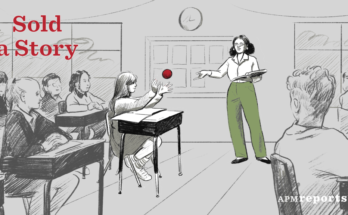

By the time many of my high school students enter my algebra class, they already know what their school thinks they are bad at. They wear labels before even opening a notebook: “corrective”, “unmotivated”, “underperforming”.
Too often, personalized learningstarts with these labels. We start with a low score or what we think students can’t do – a missing skill or academic gap – and then we build instruction around that solution.
I think we have to start elsewhere: with what interests students, what they want to become and what already has meaning for them.
The starting point is important because personalized learning is meant to do more than address academic gaps. Personalized learning is meant to tailor teaching and learning experiences to support a student’s individual strengths, needs, interests, goals, and pace.
But if it fulfills that promisedepends on the information we choose to provide to prioritize. This prioritization is all the more important as artificial intelligence plays a greater role in personalized learning.
Related: There’s a lot going on in classrooms from kindergarten through high school. Follow our free weekly K-12 education newsletter.
AI offers teachers like me new ways to quickly adapt teaching. It can create practice problems, adjust reading levels, provide immediate feedback, and generate materials based on student needs. But technology can only personalize the information we choose to provide.
This is why I think a better approach to personalized learning with AI is to provide it with information to build learning based on the student’s interests and goals. Otherwise, we risk using new technology to consolidate an old approach instead of making learning more meaningful.
I saw what the difference might look like with a student I’ll call Kyle, who recently asked me, “If my phone can solve this problem in two seconds, why do I have to learn it?”
It wasn’t a disrespectful question. It was honest. In the age of instant answers, more and more students are likely to ask the same question.
I could have responded with the usual answers: Because it’s on the test, because you need the credits, because you’ll need them later.
Instead, I asked him what interested him. Kyle started talking about cars, music, and wanting to make money. This conversation opened the way to mathematics for us.
Once I understood what mattered to him, I was able to use AI-based personalized learning differently. I used it to generate examples related to his interests, like comparing car loans and monthly payments and the long-term cost of financial decisions.
Because of his interests, I was also able to give him work that allowed me to learn more about his abilities than a worksheet or test score could have shown me. I saw how he reasoned when the context mattered to him. I saw where he was stuck and I saw what kept him going. His confidence changed because mathematics was no longer imposed on him. It became something linked to his future.
Generative AI can already support personalized learning in all the ways mentioned above. But if we don’t pay attention, AI will sort students based on what they can’t do yet and call that innovation.
Related: OPINION: In the rush to adopt new AI technologies, let’s not forget the human touch
This is why I worry when personalized learning is defined solely by academic achievement. Of course, I need to know where students are having difficulty. A math teacher like me cannot ignore gaps in understanding. But a student who struggles with equations can still be a keen thinker when math is related to business, family responsibilities, or sports.
In my class, I learned that interest should not distract us from rigor. This is often the entry point. AI helped me create relevant practice faster, but it didn’t create the reason to learn. This comes from Kyle’s own goals and the conversations we had in class.
Academic data alone cannot tell me who a student is, how they think, what they value, or what might push them to struggle with something difficult. Starting with Kyle’s interests did not lower math expectations. This gave me a better way to help achieve them – with the help of AI.
This is the role I think AI should play in personalized learning.
The starting point should be: what are my students interested in? What are they trying to become? What already makes sense to them?
AI can then help me personalize the work and find ways to make it meaningful to them. In doing so, my relationship with my students will deepen.
For students like Kyle, starting with who they are rather than what they lack is what makes deeper learning possible. Knowing what matters to my students changes the way I understand what they are capable of.
Al Rabanera teaches mathematics at La Vista High School in Fullerton, California. He is a Teach Plus Leading Edge Educator member 2025-27.
Contact the opinion editor at opinion@hechingerreport.org.
This story on personalized learning was produced by The Hechinger reportan independent, nonprofit news organization focused on inequality and innovation in education. Register with Hechinger weekly newsletter.
The article TEACHER’S VOICE: The future of personalized learning cannot be built on technology alone appeared first on The Hechinger Report.