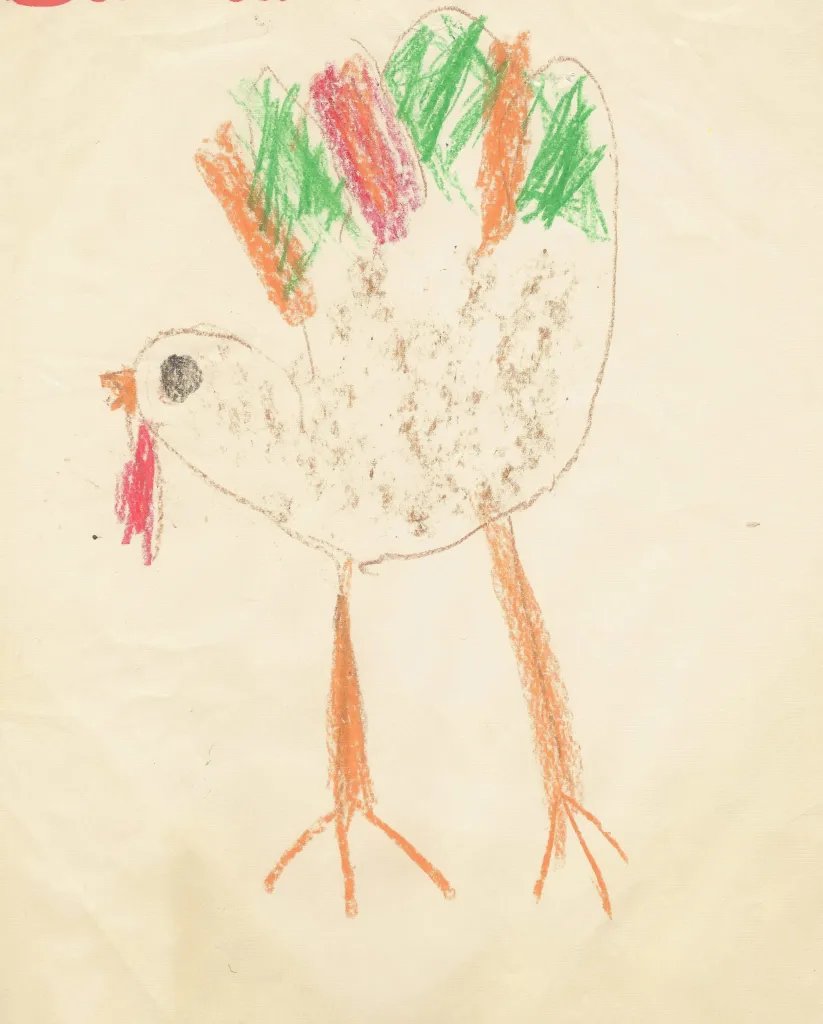

You may remember a teacher who handed you construction paper every November and told you to trace your hand and turn each finger into a colorful feather. Perhaps you had permission to choose the colors of each feather. Maybe you stuck to just one wonky eye.
But the product, the process and the definition of success for this project had already been decided. You’ve made a turkey by hand.
Here’s why I hate hand-held turkeys.
I suspect no one asked what You wanted to create. The goal was to follow the steps, fill the wall with 25 nearly identical Stepford birds and call it art.
I’m 100% sure no one has explained how or why a construction paper turkey became the elementary school age equivalent of a Thanksgiving gratitude meditation.
This wasn’t the result of some runaway holiday tradition or even bad practice on anyone’s part. This reflects the residue of outdated arts education policies.
Related: There’s a lot going on in classrooms from kindergarten through high school. Follow our free weekly K-12 education newsletter.
Visual arts and music have been an official part of the American public education system since the 19th century. However, for most of this history, they have been treated as “special” or relegated to “extracurricular involvement.” This began to change in 1994, when arts educators wrote the first national art standards and federal law designated the arts as an essential academic subject.
However, the standards were voluntary and the accountability systems that reshaped math and reading never extended to the arts. Most states subsequently adopted their own arts learning standards. In IllinoisWhere I worked in arts education, the standards boiled down to three concepts: knowing the vocabulary of the arts, understanding how art is created, and understanding the role of the arts in history.
This seems pretty reasonable on paper. But when you step back and consider how it works in practice, it comes down to an exercise in compliance: rote skills and knowledge reproduced correctly. Think about every student shouting “Hot Cross Buns” on the recorder or every child reciting their assigned “Romeo and Juliet” balcony monologue. These are activities that favor conformity rather than curiosity, mimicry rather than meaning.
This approach treats the arts as linear: children learn a technique or fact, and their job is to faithfully generate the desired product.
It took until National Basic Arts Standards were developed collaboratively and published in 2014 so that the field could formally reinvent this model. The new holistic framework asks students to walk through the entire artistic process: generating and developing an idea; create and present this idea in some way; analyze and receive feedback on their creation; and make connections between them and the choices they made.
Create, play, respond, connect. It is a loop that can be repeated from kindergarten through high school, with increasing sophistication, collaboration, and independence, always keeping the student’s unique artistic point of view at the center.
Hand turkeys, both literally and figuratively, represent what happens when schools skip that loop and focus solely on product-based arts education. This still happens daily in classrooms. Examples of hand turkey waste education far beyond what currently graces November bulletin boards across the country.
The problem isn’t the turkey itself; I’m not here to vilify all poultry art. The question is whether a student has a role in deciding what to explore.
Definitions of “good” arts education techniques and artifacts are often rooted in narrow, Eurocentric ideas about what counts as art, theater, literature, or achievement. Students may learn that it is good to reproduce the work of people and traditions far removed from their own lived experience.
We send the message, implicitly or explicitly, that the more you can trace someone else’s contours, the better off you are.
With this model, many children (who become adults, some of whom may be reading this) come to believe that they are not artistic. They internalize the idea that artistic talent is defined by what they produce, rather than the thought, imagination, and ingenuity they bring to a problem.
They come to accept the message that creativity is about doing things right instead of daring to see and create something new. How many people have told you, spontaneously, that they are “not art enthusiasts” or that they do not know how to draw, sing or dance? Chances are they were raised to believe that if they couldn’t produce the version of turkey that was handed to them, they weren’t being creative at all.
Parents: Do you have a hand turkey stuck on your fridge right now?
The sole purpose of arts education has never been to teach students to draw, sing or dance. I believe it exists to teach students that their perspective is unique, powerful, and worth defending.
Related: PROOF POINTS: The lesson the arts teach
To fully focus on the artistic process, the entire arts education sector must evolve together. We can encourage this in three ways.
First: Teacher preparation programs must reinvent their curricula to ensure that new arts educators recognize and can apply this iterative approach across arts disciplines, rather than focusing on discipline-specific skills.
Second: Access to arts education, which remains wildly unequal across schools, grades, and districts, must be defended even in the face of competing priorities and difficult financial realities.
Third: Perhaps most importantly, it’s time to remove the pressure on arts teachers to produce something brilliant for the hall or spring concert. Let art rooms become noisy, process-focused laboratories.
We need K-12 schools where bold ideas are welcome; the final products may seem a little complicated; feedback is generative; and students and teachers can defend their choices without fear of being told they didn’t trace their hand correctly or colored outside the lines.
Julia deBettencourt is Chief of Staff, Portfolios, at Bellwether. She previously worked as executive director of arts education in Chicago Public Schools.
Contact the opinion editor at opinion@hechingerreport.org.
This story about arts education was produced by The Hechinger reportan independent, nonprofit news organization focused on inequality and innovation in education. Register with Hechinger weekly newsletter.
The article OPINION: That Thanksgiving construction paper turkey on your refrigerator is actually an education policy failure, which appeared first in the Hechinger Report.