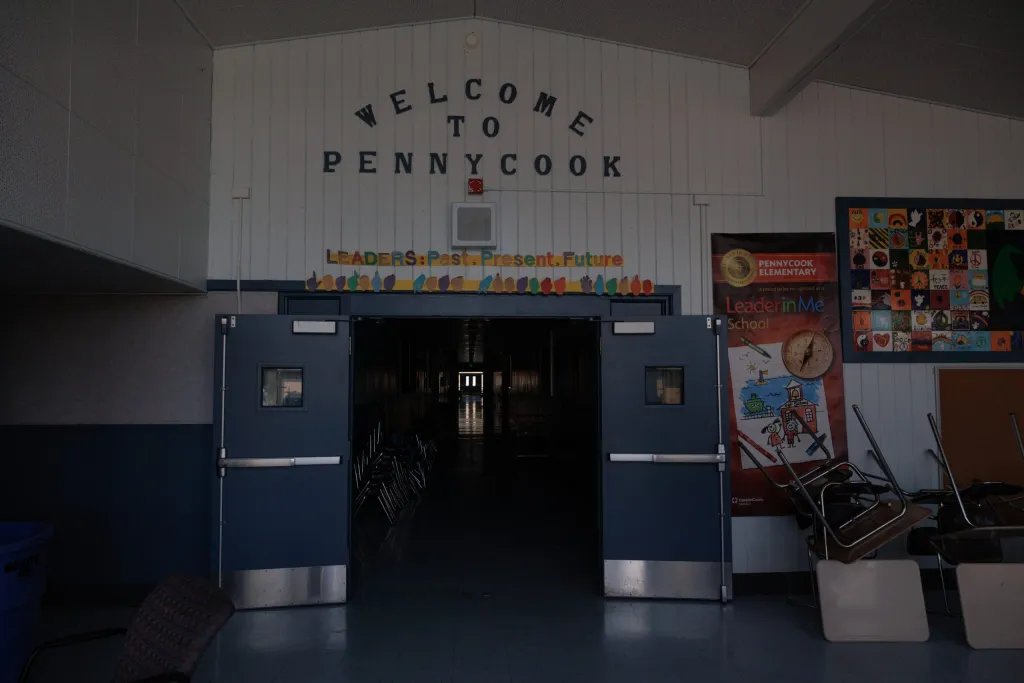

The start of the school year can be stressful in all circumstances. But for thousands of students across the United States, this school year has brought the added difficulty of adjusting to a brand new school after the previous one closed.
Like the United States birth rate Continuing a decades-long slide and as state and federal education funding dries up, a growing number of cash-strapped school districts across the country have resorted to campus closure to save money.
At the same time, new search shows that student enrollment fell much faster than school closures, suggesting more painful financial choices lie ahead.
AP covers school closures in partnership with The Hechinger report and Big Local News at Stanford University. These are some takeaways from their reporting.
A total of 1,156 U.S. schools closed their doors during the last school year — the highest number since the pandemic, according to an analysis of federal data by Stanford University’s Big Local News.
For example, the city unified school district of Vallejo, a working-class neighborhood near San Francisco, enrolls half as many students as it did two decades ago. District leaders have closed five campuses since 2025, or a quarter of its schools. They also placed up to a third of all staff positions on the chopping block to help close a staggering $36 million deficit.
In Vallejo, a city still struggling to recover from the closure of a naval base in the 1990s, school enrollment fell by nearly 18,000 in fall 2006, to about 9,300, according to the district. But school districts across the country, including the large systems of Cleveland, Houston and Philadelphia, are facing similar closures.
Enrollment and the financial situation are unlikely to improve, said Lydia Rainey, research director at the Center for Reinventing Public Education. “States are not ready to open the coffers and provide additional funds to save schools,” she said.
Nationally, public school enrollment fell by more than 1.4 million students, or about 3 percent, between fall 2019 and 2024, according to an Associated Press analysis of federal education data collected by Stanford University economist Thomas Dee and sociologist Jaymes Pyne. The overall number of schools has also declined — but only to pre-pandemic levels, the researchers found, suggesting that closures are lagging behind declining enrollment.
Related: More communities are closing schools. Reductions might not be enough
Declining birth rates are the main reason for declining enrollment, but a immigration crackdown and the post-pandemic expansion of private school vouchers And homeschool options contributed to this decline. Bellwether and WestEd, two research groups, recently estimated declining enrollment could result in an annual loss of $11.5 billion in state revenue to schools by 2030-2031, which could lead to widespread layoffs, cuts to academic programs and school closures.
Research shows closing of schools rarely gives Financial relief districts hope for. Busing students to their reassigned schools, severance packages for staff in pink underwear, and security for empty facilities often eat up any savings. School closures can also set students back academically and make it harder to attract teachers, who may worry that jobs won’t be stable.
Closing schools may trigger a downward spiralalso, as frustrated families flee to charter or private schools or other districts. In Vallejo, some parents said they chose to homeschool this fall or were considering selling their homes and moving to neighboring districts.
“Families are literally packing up their kids and moving,” said Vallejo mom Kimberly Núñez-Brandão, whose daughter’s elementary school closed. She recently attended a teaching night for her daughter’s new school, Glen Cove Elementary, and shared her shock to learn that Penny’s new fifth-grade teacher had 32 students in her first class.
“They have already overwhelmed the teachers with over 30 students,” she said. “Who wins here?”
Rubén Aurelio, Vallejo’s superintendent of schools, acknowledged that cuts and closures can be difficult for families, but said they are necessary to correct school districts and budgets designed for a different reality.
“We’re not just closing schools for the sake of closing schools,” Aurelio said. “We’re right-sizing a district that was built to accommodate a lot more kids. And if we really want to improve outcomes for the kids we still have, we need to focus resources.”
Already painful cost-cutting measures could push even more families toward competing charter networks, neighboring districts or private alternatives — further eroding funding schools receive per enrolled student.
So in addition to cutting budgets, Vallejo is renovating older campuses, hoping to attract younger parents who can’t afford to start a family in San Francisco. The principal said he also plans to open a Tagalog language school soon, targeting Filipino families throughout the Bay Area.
Marisa de la Torre, executive director of the UChicago Consortium on School Research, said the instability created by school closures could last for some time. Studies of University of Chicago show that academically, displaced students often experience long-term declines in reading and math. This is especially true when students end up in low-performing schools.
“It takes them a while to recover, if at all,” she said.
Núñez-Brandão isn’t sure she wants to stick around long enough to find out.
A few weeks into the new school year, Penny was still struggling with the transition to Glen Cove. She began making new friends and said she felt comfortable on campus. She also loved her teacher, a first-grade educator who had joined the Vallejo school. teacher residency programlaunched last year to attract new educators and improve retention.
But with 32 children in the class, she says it’s hard to concentrate.
On a Tuesday in October, Núñez-Brandão received a note on the Glen Cove parent portal: Penny’s teacher had resigned, effective immediately. The school will rely on a long-term substitute for now, the district said.
Contact staff writer Neal Morton at 212-678-8247, on Signal at nealmorton.99 or by email at morton@hechingerreport.org.
This story of closed schools was produced by The Hechinger reportan independent, nonprofit news organization focused on inequality and innovation in education, in partnership with the AP and Stanford University’s Big Local News. Register at Hechinger Newsletter.
The article Takeaways from our report on U.S. school closures appeared first in The Hechinger Report.