Londoners face record levels of subsidence risk after five consecutive heatwaves dried out clay soil in much of the capital.
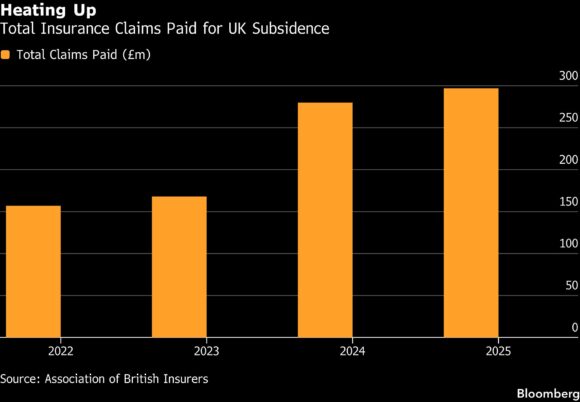
Figures provided by the Association of British Insurers show that insurance claims related to land subsidence hit a record high last quarter. Land subsidence is a phenomenon associated with hot, dry weather that causes soil to shrink and damage building foundations. On average, households claimed £20,000 ($27,200) for the risk, more than in any previous quarter and up 15% on the same period in 2025, the ABI said.
Laura Hughes, head of general insurance at ABI, said the upward trend was likely to continue. “We expect to see more subsidence because of the hot weather,” she said in an interview.
Londoners expressed their frustration on social media. On Reddit, people provided personal accounts telling how “terrible crackIn their home, “the door was stuck” due to the sinking. One said it was “really scary” to find their kitchen had moved with the movement of the home’s foundation.
Another Reddit user described the response from the structural engineer they contacted for help. “Before I could finish explaining, he laughed and said, ‘You and 20,000 other people in south-east London,'” the person wrote.
“It’s crazy what’s happening right now,” said Otso Lahtinen, chief executive of Geobear, an engineering firm often called upon to repair damage caused by subsidence. “This is the new normal, and it looks like it’s going to happen more frequently over the next 20 to 30 years.”
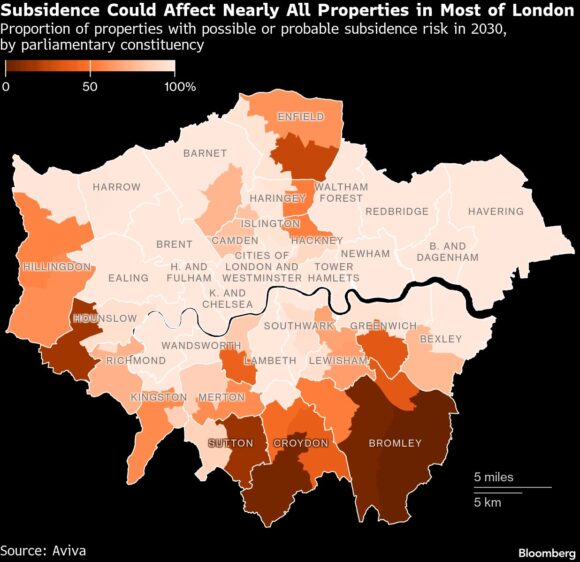
Data provided by Aviva Plc showed that the areas in London most at risk are some of the British capital’s most popular boroughs, namely Westminster, Kensington and Chelsea. Although land subsidence has been affecting homes in the British capital for decades, climate change is making the situation worse. London Clay is particularly sensitive to moisture fluctuations, swelling when wet and shrinking when dry.
The threat of subsidence in the UK is concentrated in and around London and parts of the south-east. According to data provided by the ABI, insurance payouts for subsidence damage soared by around 90% in the four years to 2025, reaching a record £297m.
The most vulnerable properties are Victorian or Edwardian houses built directly on top of London Clay. In comparison, modern office buildings in the City of London and Canary Wharf have deeper foundations and are therefore less exposed to such risks.
Subsidence is part of a long list of heat-related challenges the UK is currently grappling with. Over the past few months, extreme heat has forced schools to close, led to bus driver strikes, and banks have relaxed office work requirements to protect employees from unbearably hot commutes. Much of England has suffer from drought The country’s hospitals are also showing signs of being overwhelmed.
London Mayor Sadiq Khan has warned that the city will need to seek help from private investors to cover the costs of dealing with the impact of rising temperatures. His office estimates London faces costs of up to £36 billion a year by the 2050s to prepare the city for climate change.
“The impacts of climate change are undeniable,” said ABI’s Hughes.
Settlement can devalue property According to the Federation of Master Builders, the average reduction is 20%-25%. In some cases, homeowners prefer to shoulder the costs themselves rather than wade through the complex claims process. The cost of traditional engineering repairs to settlement damage, known as foundation shoring, can range from £20,000 to over £100,000.
This development represents a particular risk for insurance companies as subsidence claims represent an increasing proportion of the benefits they need to pay to their customers.
Cherry Chan, a partner at Deloitte, said the phenomenon “poses a significant challenge for UK home insurers”. The consulting firm has Warning for British Home Insurers Risk losses in 2026 are partly attributable to this trend.
In addition to flash floods and wildfires, land subsidence is becoming a “growing climate-related risk,” Chen said. It requires insurers to “carefully consider long-term risks and risk management strategies.”
She added that extreme weather patterns in 2026 “will not only impact more new claims this year, but may also lead to a worsening of claims status for unresolved subsidence claims reported in the past”. These include 2025, the so-called surge year in subsidence impacts.
Latest estimates from the British Geological Survey suggest that 1.8 million properties – around 5% of the UK total – are “extremely likely or very likely” to be affected by contraction-expansion subsidence by 2070 under the so-called RCP 4.5 emissions scenario – which reflects a trajectory closely aligned with current climate policy. Under the higher emissions scenario, This number rises to 4.2 millionor 11% of UK property. Areas most at risk are densely populated areas of London, Kent and south-east England.
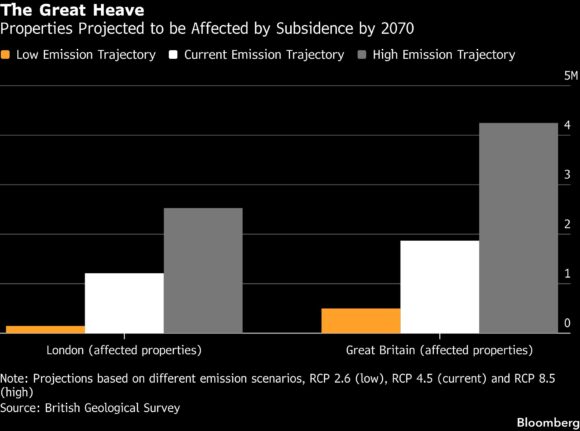
BGS said the development had the potential to lead to “increased insurance premiums, lower house prices and, in some cases, land or property stabilization works, replacement of utility pipes and destabilization of transport infrastructure”.
Geobear, which solves subsidence problems by injecting resin under buildings, said it has received more inquiries from homeowners this summer than ever before. The company said insurance customers confirmed a similar trend, with one customer telling Geobear the company received 180 claims in a single day, which was significantly more than normal.
“This is a pretty serious situation,” Chief Executive Officer Lahtinen said. “If you’re looking to trade, sell or buy property, this is a trend you can’t ignore.”
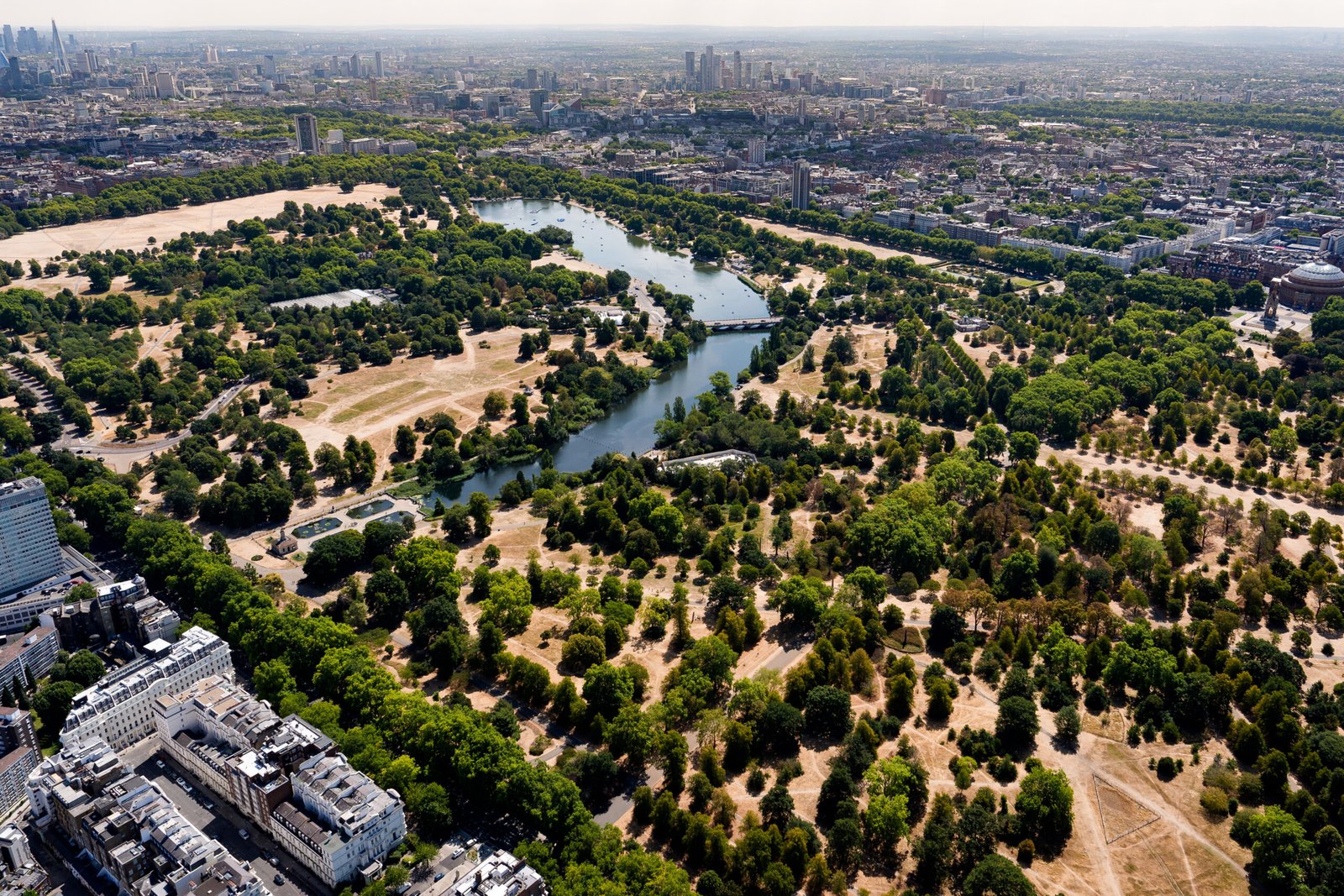
Photo: Central London during a heatwave in July 2026; Photo credit: Aaron Chown/PA Images/Getty Images
Related: London is in decline due to climate change
Copyright 2026 Bloomberg.