
Preschool education is often judged by how quickly children master the 3 Rs: reading, writing and numeracy. These skills are essential, but not sufficient.
Children also need the 3 Cs: curiosity, creativity and critical thinking.
We often view the 3 Cs as “must-haves” once children have mastered reading, writing and arithmetic. But that sets the sequence back.
Curiosity attracts a child to a book. Creativity connects ideas in new ways as the child reads. Critical thinking helps the child evaluate whether these ideas fit together.
The 3 Cs are not a reward for completing academic work. Instead, they stimulate learning and make it stick.
Few educators would say that the 3 Cs are not important. The problem is that we have organized preschool education around the 3 Rs. Additionally, our approach to these core skills often reflects a predominantly academic teaching style in the early years, with a proliferation of scripted curricula, worksheets, exercises, and questions with a single expected answer. I propose integrating the 3 Cs into early learning at school and at home through conversations rich in exchanges, open questions and guided games.
Related: Young children have unique needs and providing the right care can be a challenge. Our free early childhood education newsletter tracks issues.
In the early years, children learn what thinking looks like and discover with pride and enthusiasm that they can generate their own ideas. Let’s take two pre-kindergarten classes:
In the first, a teacher asks: “Which tower block is tallest?” » An enthusiastic child gives the correct answer and the teacher moves on to the next question.
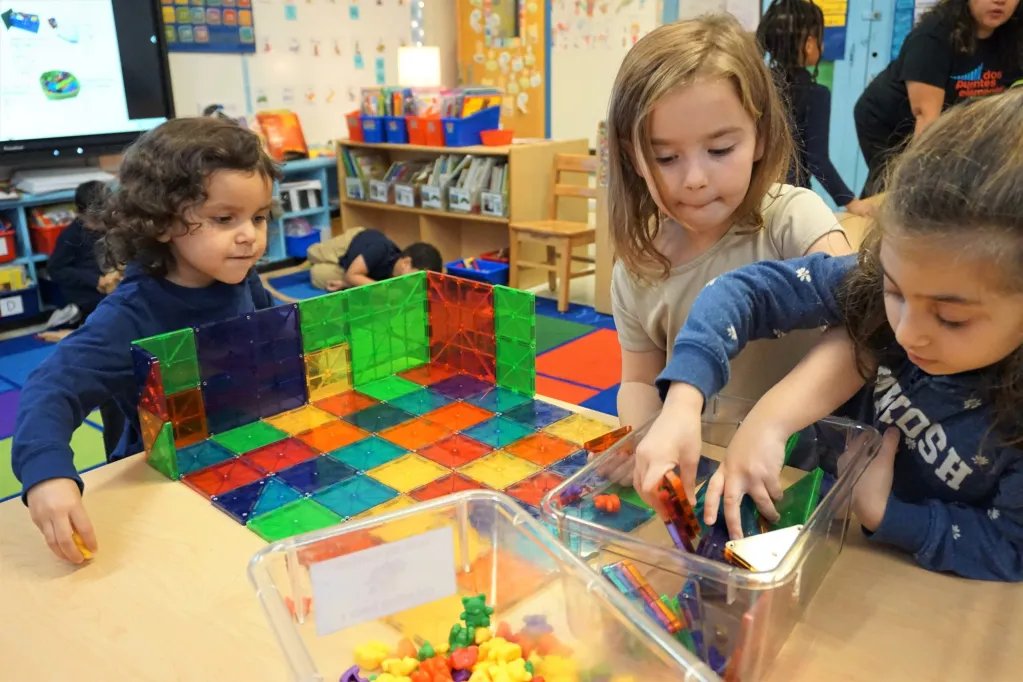
In the second, the teacher asks: “Why did this tower fall while the other remained standing?” » She waits and invites the class to test her explanations through a guided game.
Both resemble learning, but only the second engages the scientific method. By explaining, predicting, testing and reconsidering, children learn that ideas can be improved.
At ages 4 and 5, children develop executive skills, including the ability to concentrate, persist, and organize their behavior. Kimberly Nesbitt and Dale Farran find that social and highly engaged classroom activities are associated with greater gains in executive functions, particularly for children who enter pre-kindergarten with low skills.
Rich conversations exercise language and self-regulation together.
Today, as AI makes it easier to get answers, it is even more important that children learn to ask the right questions and judge the answers they receive. Adults capable of judging the performance of a machine can delegate some of the cognitive work with few adverse effects. But a 5 year old child is still developing this judgment; there is no shortcut to building it.
Curiosity is developed by asking a question and learning that it leads to other questions. Creativity thrives by generating possibilities and deciding which one to click on. Critical thinking develops by comparing claims to existing evidence.
Children strengthen these skills through active, repeated practice.
My research team observed 17 Chicago-area preschool and kindergarten classes, examining the questions teachers asked and how they engaged children in conversation. Teachers asked closed questions almost three times more often than open questions.
This is not due to indifference: all 21 teachers we interviewed rated rich conversations as very or extremely important. However, most had no training in effective language interactions with young children. Many cited time or uncertainty as barriers to starting open conversations.
Imagine a kindergarten teacher who wants to teach the word “oasis.” She shows a picture of a green, wet area in the desert and asks what the children notice and why the oasis might exist. Children learn where water comes from, how an oasis benefits neighboring plants and animals, and how often oases occur.
Children ask questions, offer explanations, and build on each other’s ideas as they work to understand the unknown word. In this approach, the child learns the word “oasis” and much more.
Related: TEACHER’S VOICE: Here’s why teachers should help students develop logic and reasoning skills from an early age.
Teachers and parents bring distinctive strengths to this approach. Teachers can connect open-ended conversations to lesson plans and provide children with repeated opportunities to reason with their classmates. Parents know the child’s experiences, interests, language and ways of expressing ideas. During ordinary times at home with a parent or guardian, a child can revisit the topic in a familiar setting, explore it more deeply and relate it to everyday life.
When teachers and parents reinforce this approach together, children experience the 3 Cs in both places where they spend most of their early childhood.
Most school-to-family messaging platforms focus on logistics. A true home-school connection is different. A teacher giving a physics lesson sends a request to parents: “Ask your child where his shadow is going. » The parent reports that her daughter noticed that her shadow changed length when she passed a lamp post.
The teacher kicks off the next morning’s class discussion with this response, opening a new conversation about how light travels in straight lines. The child’s idea travels from school to home and back, becoming richer as it goes.
This approach is particularly important for children who have the least opportunities to have rich conversations. This requires more attention than expertise.
A parent who doesn’t know how to talk about shadows doesn’t need to take a crash course in the physics of light. This parent needs a good question and a willingness to sincerely listen to the child’s response.
There are resources to help you. In our research laboratoryfor example, we developed the model aimed at adults Chat2Learn tool, which gives teachers and parents open-ended prompts to start rich conversations.
We must continue to teach the 3 Rs directly and well. But we should stop treating curiosity, creativity, and critical thinking as accessories to the “real work” of reading, writing, and arithmetic.
The 3 Cs are the real work, especially in the early years. Parents and teachers can support this work together by imparting knowledge to children, listening carefully to their ideas, and making room every day for questioning, imagining, explaining, and revising.
Ariel Kalil is the Daniel Levin Professor at the Harris School of Public Policy at the University of Chicago, where she directs the Center for Human Potential and Public Policy and co-directs the Behavioral Insights and Parenting Lab.
Contact the opinion editor at opinion@hechingerreport.org.
This story about teaching critical thinking, curiosity, and creativity was produced by The Hechinger reportan independent, nonprofit news organization focused on inequality and innovation in education. Register with Hechinger weekly newsletter.
The article OPINION: It’s time to prioritize curiosity, creativity and critical thinking in the early years of learning appeared first on The Hechinger Report.