
WASHINGTON – Trinity Williams has some advice for prospective students visiting Howard University since the Supreme Court barred colleges from considering race in admissions.
“Always choose an HBCU,” Williams, a student and tour guide at the historically black university, told me on a recent October day, recounting the pep talk she likes to give to high school students. Howard, a leading private research university, opened in 1867 to educate newly freed African Americans and train black clergy and teachers. iconic alumni and an integrated advice and support network that Williams hopes to benefit from.
“Our students are competing at a higher or more elite level,” Williams said. “Companies, organizations, businesses – they know they can come to Howard and find students prepared, mentored and trained. I always encourage students of color to come to HBCUs.”

I was struck by Williams’ optimism about career prospects in a tough job market, as my conversation with her followed months of reporting by the Hechinger Report and Soledad O’Brien Productions who found the opposite. In our ongoing series on the end affirmative action, students and some guidance counselors we spoke with denounced what they called a disappearance of recruiting efforts on their campuses following the court’s decision, hastened by decrees of President Donald Trump banning diversity, equity and inclusion initiatives.
At San Jose State University in California, Daniella Mensah, who was 2 years old when her family emigrated from Ghana, worried that students like her — people from underrepresented groups looking for their first jobs — were increasingly overlooked due to political changes. “It’s very difficult when there just aren’t enough opportunities to get your foot in the door,” Mensah told us.
The Supreme Court’s decision did not address or change hiring laws, nor did it mention employers’ efforts to make workplaces more inclusive. In fact, it didn’t even comment on scholarships and other college programs for students of certain groups: it only applied to admissions. Yet after the ruling and Trump’s crackdown on DEI, companies dismantled the candidate recruitment programs they once sought: they deleted or revised language of diversity and reconsidered how they built candidate pools, Columbia Business School Research found – largely because they feared becoming the target of lawsuits, public criticism or political attention.
Our own reporting confirmed it: Pipelines for black, Hispanic and first-generation students “have dried up,” Jamila Chambers, executive director of the career center at Occidental College in Los Angeles, told us. We also found that fewer of these students were benefiting from certain corporate internships, which employers had relied heavily on in previous years to diversify their workforce.
And while nearly 60% of 150 large employers surveyed by recruiting research firm Veris Insights identified diversity as a priority in determining where to send recruiters to campuses in 2022, that figure had fallen to 31 percent in 2025.
Related: Less Race-Based Scholarship and a New Culture of Fear Follow the End of Affirmative Action
Preliminary the data shows that many elite colleges are seeing changes in the number of incoming students since the Supreme Court decision: At Harvard University, one of the defendants in the Supreme Court case, the percentage of black incoming students has fallen by almost half since 2023, from 18 percent of the freshman class that year to just 9.3 percent this year.
Positive action
This story is part of a series produced by The Hechinger report And Soledad O’Brien Productions on the continuing impact of the Supreme Court’s decision.
There is also a “cascade effect” with high-achieving black and Hispanic students not being accepted to highly selective colleges, but attending less competitive colleges, leaving fewer spots at those schools for other students from underrepresented groups, according to Julie Parkprofessor and author of several works on positive action.
“The decision itself has taken on a new life that none of us anticipated in terms of how Trump has referenced it and exploited it to crack down on DEI across the country,” Park told me. “So the chilling effect on everything from recruiting to program types is much more widespread than we could have predicted.”
Related: Opinion: There’s a ‘cascading effect’ from the Supreme Court’s ruling on affirmative action, and it’s hurting Black and Latino students
Search for The Burning Glass Institutethe nonprofit research firm we collaborated with for this project, found that recruiters visiting campuses look to a smaller set of largely private, elite universities where incoming classes are less and less diverse.
These types of highly selective institutions – often called “Ivy-Plus” – have historically been a great equalizer for underrepresented students. Students who attend them increase their chances of reaching the top 1 percent of the graduate income distribution by 60 percent, while nearly doubling their chances of attending an elite graduate school and tripling their chances of working at a prestigious company., research shows.
I couldn’t help but ask many of the people I spoke with on this project how this so-called “blue wave” who delivered a major criticism Trump will change the landscape. There is now a new list of elected officials from various backgrounds, including Hakeem Jeffriesset to become the first black speaker of the House of Representatives, a Native American senator from Minnesota and, for the first time, an openly female gay man in the New Hampshire Senate.
“I think this will stem attacks on DEI-related supports on campus, which can help students who end up on selective college campuses succeed,” Natasha Warikoo, a professor at Tufts University who has also written extensively about affirmative action, told me.
Joni Hersch, professor of law and economics at Vanderbilt University whose research is cited in an amicus brief in the Supreme Court case, said: “I think the strong message is that companies and other institutions can return to their (entirely legal) hiring and training policies that they had before Trump’s attack on everything he considered DEI and the public will not be shaken.” She added, however, that she didn’t think companies would “necessarily be outspoken about their commitment to diversity.”
David Hinojosa, co-director of litigation at the National Youth Law Center, told me he doesn’t expect the administration to relax its attacks on diversity. “Their intention to ensure that privileged white people get to the front lines remains at the heart of their mission,” he said.
Related: Tracking Trump: How He’s Dismantling the Department of Education and More
However, Hinojosa, who argued for race-conscious confessions during Supreme Court hearings on affirmative action, believes that if a new Congress can prioritize enforcement of civil rights laws, it could “help take some of the momentum off the anti-DEI campaign.”
Michael Collins, a senior vice president at the nonprofit group Jobs for the Future, told me he thinks recruiters “will continue to be wary of anything that looks like a race/gender preference” — which continues to be a problem for colleges and universities as well: Last week, the Hispanic Scholarship Fund agreed in a regulation to open scholarships reserved for Hispanic students to all races.
“That’s not to say that recruiters won’t look for diverse candidates,” Collins told me. “If they do it, I have a feeling they will do it in a way that won’t invite a legal challenge.”
Back at Howard, Williams acknowledged that she wasn’t sure students at lesser-known HBCUs felt as good as she did about their future prospects. Of course, any comparison comes with a caveat: HBCUs represent only 3% of higher education institutions in the United States. Despite renewed support of Trump, many are faced with a multitude of financial difficulties.
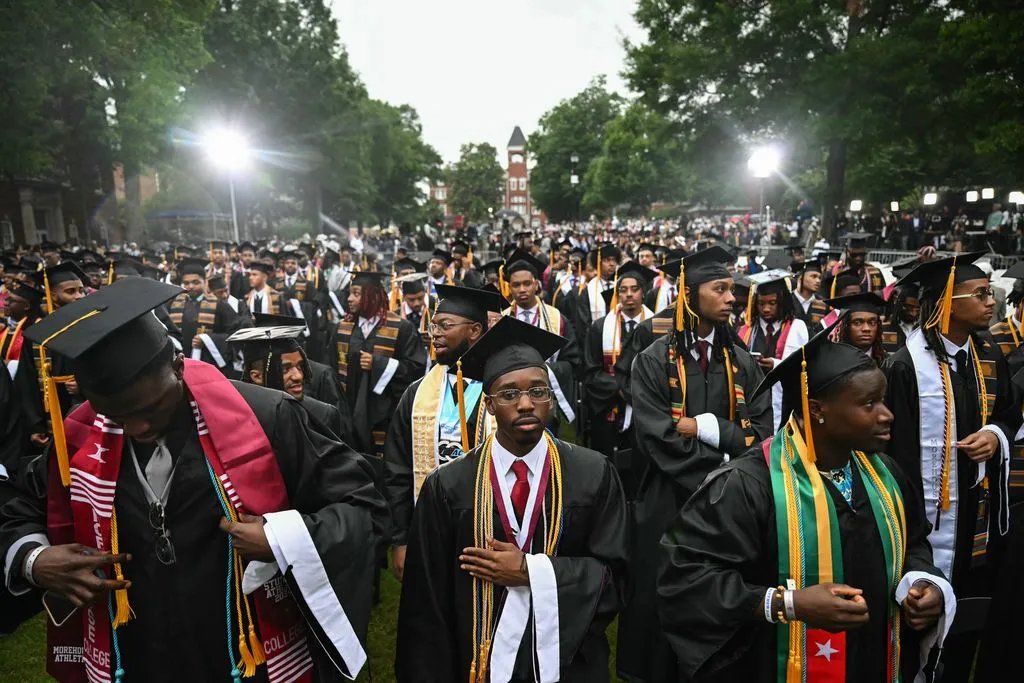
Yet top HBCUs remain a beacon for students like Williams, as they were for Jonathan E. Collins, executive director of the Center for Educational Equity and a professor at Columbia University’s Teachers College, who proudly displays a banner from another renowned HBCU, his alma mater. Morehouse College, in his office. (The Hechinger Report is an independent unit of Teachers College, Columbia University.)
At Morehouse, Collins saw first-hand “how large corporations, consulting firms, and graduate schools were actively recruiting students. They were creating important opportunities for talented black students to access professional networks that might otherwise have been difficult to enter.”
Related: Colleges Shouldn’t Be Punished for Giving Every Student a Fair Chance
Of course, turning to HBCUs doesn’t change the whole picture for students whose track record in previous decades before the Supreme Court’s decision gave them an advantage. And once more data becomes available, the impact could be much greater.
“We probably haven’t seen the worst yet, because the first students admitted after the affirmative action decision generally won’t graduate until 2028,” Collins told me. “The consequences of full employment are therefore still ahead of us. »
Stephen Kastenbaum and Maxine Paul Emile contributed to the report on this subject story about the end of positive discrimination. It’s tthird in a series of articles accompanying a documentary produced by a partnership between The Hechinger report And Soledad O’Brien Productions on the continuing impact of the Supreme Court’s decision. Hechinger is an independent, nonprofit news organization focused on inequality and innovation in education. Register at Hechinger Newsletter. To contact the editor on this story, contact Willen@hechingerreport.org
The post COLUMN: Will the Blue Wave Reopen Job Opportunities for Black and Hispanic Students? appeared first in the Hechinger Report.