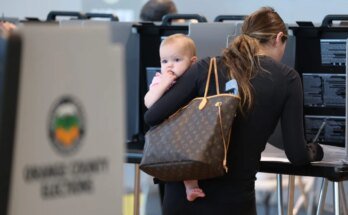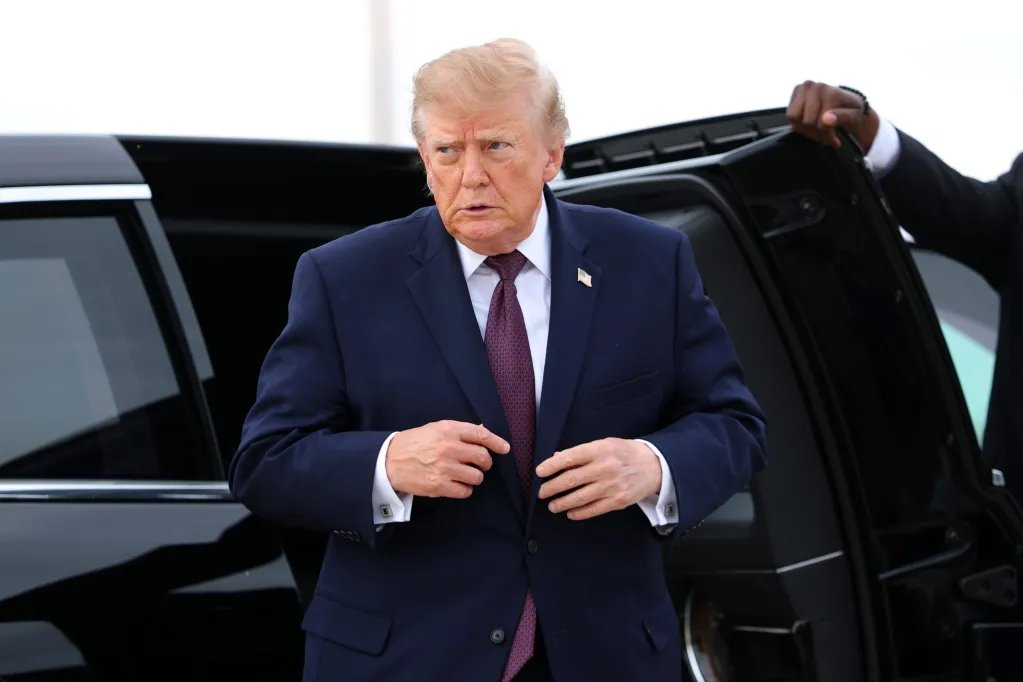

Elections have consequences. President Trump released decrees motivated by suspicions of voter fraud, pushing blue states to purge voters. The Justice Department went on a rampage to stop polls, investigate poll workers, and preemptively investigate results that might not favor the president and his party.
It is the federal government that legitimizes political recalcitrance.
And it’s also a reminder of the many historical events that have shaped American history, in many cases because of elections, and why this one worries me.
What will happen if much of America loses, not gracefully but violently? This raises concerns about public safety, financial market instability, and militarized law enforcement.
It could start with President Trump, at best, publicly casting doubt on what is shaping up to be a resurgence of Democratic Party power in Congress, and at worst using executive power to flatly deny it. The results could become a defining moment for America – the beginning of the end of a never-perfect union.
One such historical lesson occurred in 1873, when more than 100 black men were massacred in cold blood by a white militia in Colfax, Louisiana. It was Easter Sunday. President Ulysses S. Grant was forced to send in the National Guard to restore order.
An angry mob of insurgents was pursuing its own “resurrection,” the rebirth of the old Southern Confederacy. What is now infamously known asColfax Massacreled to lifeless black bodies piled into mounds and dumped into the depths of the Red River.
The previous year, William Pitt Kellogg (a pro-civil rights Republican) was competing against John McEnery (an anti-civil rights Democrat) for governor of Louisiana, and after McEnery refused to accept defeat, his supporters rioted, with the worst of the violence occurring in Colfax.
This is the kind of danger that looms over the 2026 midterm elections.
Preventing political divisions begins with a series of simple choices: accept election results (win or lose), fight unfair attempts to limit voting rights, and allow truly independent courts to monitor the political process.
Related: Tracking Trump: How He’s Dismantling the Department of Education and More
For proof, look no further than Louisiana. Even after Grant’s intervention, Governor Kellogg’s tenure remained controversial, with his victory contested by rival Louisiana Democrats in the state legislature throughout his term.
In the end, theyindictedhim. His successor and fellow pro-civil rights Republican, Stephen Packard, held out for three months before anti-civil rights Louisiana Democrats took the reins of the state legislature and removed him from office.
It was only through the Compromise of 1877 – in which Republicans ceded the governorship to Democrat Francis Nichols in exchange for the Louisiana State Legislature’s acceptance of Republican Rutherford B. Hayes as the winner of the 1876 presidential election – that order was restored.
More importantly, the agreement officially ended the post-Civil War Reconstruction era.
Louisiana and other Southern states immediately signed into law what we now call“Jim Crow Laws.”They deprived black Americans of their right to vote, while legalizing racially segregated establishments. Louisiana, in particular, has also adopted theSeparate Carriage Act of 1890.
It was the very law that, two years later, shoemaker and civil rights activist Homer Plessy deliberately violated by boarding, as a black man, a “whites only” car on a train leaving New Orleans for Covington, Louisiana.
This simple act eventually turned into a trial,Plessy c. Ferguson,which reached the United States Supreme Court and cemented state-sanctioned racial segregation as the official law of the land.
Nowhere has legalized racial segregation tainted American society more than its education system. As the Supreme Court upheld states’ rights to impose segregation, states also passed their first compulsory school laws.
Louisiana passed such a law in 1912. And so American schools in the South were segregated from the start, born of state systems actively sculpting new worlds of racial inequality.
This brings us to the present moment. What happens if the fire of political division burns through the traditional acceptance of the outcome of an election and the political division is so strong that it breaks the tradition of accepting the outcome of the election, and what if ceding power means a repeat of the1870s?
Related: Donald Trump and Teaching in a Democracy: Where Did We Go Wrong?
Midterm exams have direct implications for public education. We could see largely unregulated privatization take an even stronger foothold in the control of schools. Political gaslighting will be directed at everything from the books students read to example math problems to what we call students “managing” neurodivergence – everything will become politicized.
We will continue to see school funding evaporate in some states and magically appear in others. The American education system – the “great equalizer” that never had a real chance of living up to the nomenclature – will be the vehicle through which America’s social and political divisions widen even further.
When that happens, we will see, in half the country, a deeper distrust of the idea of public education. It is easy to imagine what this election could be the start of a system of apartheid and why we must resist any attempt to keep a child both separate and unequal.
I don’t pretend these are easy choices, but what awaits us on the other side of a deep political divide could be a bloody massacre.
Jonathan E. Collins, Ph.D., is executive director of the Center for Educational Equity and assistant professor of political science and education at Teachers College, Columbia University, a nonprofit media outlet focused on innovation and inequity in education.
This story about the midterm elections was produced byThe Hechinger report,an independent, nonprofit media outlet focused on inequality and innovation in education, subscribe toHechinger’s weekly newsletter.
The article OPINION: A warning: The midterm elections and Trump’s response have big implications for education in the United States appeared first on The Hechinger Report.