
For years, the debate about artificial intelligence and jobs has understandably focused on machines that will replace workers. People are worried about job security and employers are looking for efficiencies.
Yet as AI-driven tasks and outcomes become more common in virtually every workplace, the conversation is evolving. It’s becoming clear that the best way for today’s K-12 students to “AI-proof” themselves is to rely on human skills that AI cannot replicate.
Hiring data confirms this. A recent report found that when employers add tasks to jobs most exposed to AI, these new responsibilities are more than twice as likely to draw on human strengths such as empathy, judgment and creativity.
The change is most marked at the entry level. The same report found that junior positions with the most exposure to AI are seven times more likely than positions with the least exposure to require skills such as leadership and strategic thinking, which employers traditionally look for in more experienced workers.
The message is not that automation poses no risks or that fears of job loss are unfounded. Rather, it’s that the costs of neglecting skills like communication and collaboration are harder to ignore and that failure to develop lasting skills increases the risk.
Related: There’s a lot going on in classrooms from kindergarten through high school. Follow our free weekly K-12 education newsletter.
For many students, connecting what they learn today to how they will use their knowledge and skills in the future can be intimidating. After all, they often just hope to pass algebra.
But employers and hiring managers can take action today by engaging with their local schools. By helping students understand the skills they will need to succeed, employers can set the tone for tomorrow’s candidates.
To create a well-prepared workforce, we need to rethink how we teach these people skills from the start. Employers have been signaling this need for years.
America Succeeds and Lightcast Analysis 2025 of 76 million job postings found that 76 percent required at least one “durable skill” – an ability that remains useful regardless of changing technology or job titles – and that 8 of the 10 most in-demand skills were durable..
These typically human skills matter more than anything else on a CV. But schools rarely teach them explicitly.
Calling critical thinking, communication, and collaboration “soft skills” understates their importance in school and the workplace.
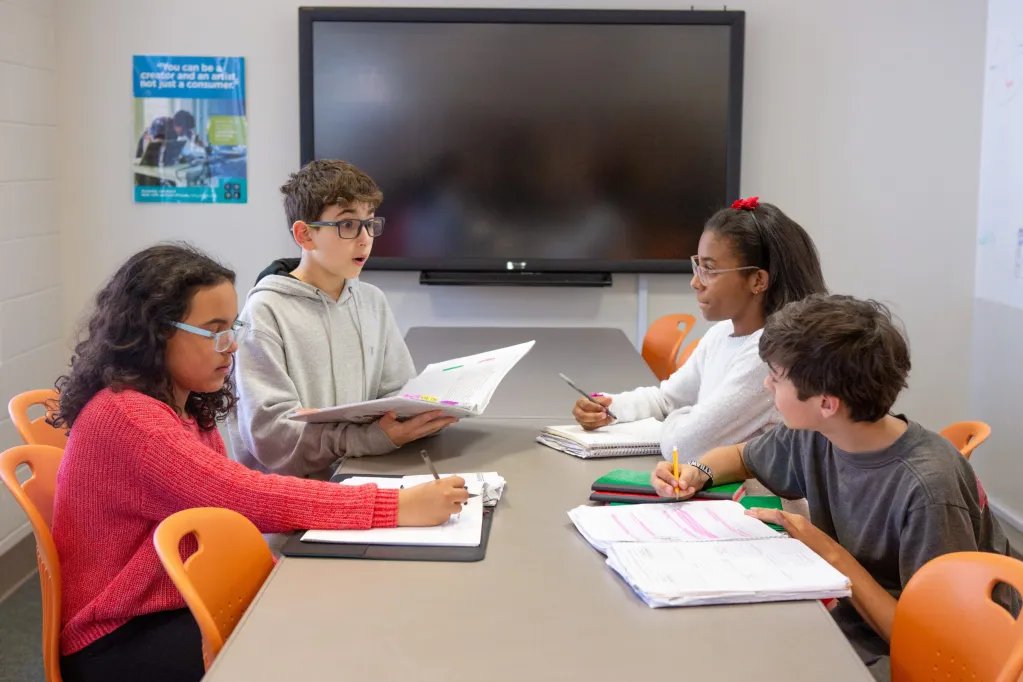
Critical thinking helps students interpret complex experiments and workers identify compelling but incorrect answers generated by AI. Communication allows students to construct evidence-based arguments and helps teams turn analysis into action. Collaboration prepares students for group projects and workplace disagreements that technology alone cannot resolve.
The promise of AI also depends on these skills. In a recent global surveyWorkers who reported using AI to save time estimated that nearly 40% of those savings are lost to correcting, clarifying, or rewriting low-quality AI-generated content. The company that commissioned the survey called it an “AI productivity tax.”
Technology has not eliminated the necessary thinking. This simply shifted the burden downstream to someone who has to catch the error.
The best preparation for working in an AI economy combines domain knowledge and AI mastery – along with the human skills needed to apply both appropriately. And this preparation must begin well before the graduate’s first job.
Related: OPINION: Do you want to make young people want to learn? Give them practical programs, mentors and skills that lead to good careers
To ensure that sustainable skills are treated as integral elements of a student’s overall education, more than 20 states have adopted frameworks that emphasize communication, collaboration, critical thinking, resilience, and other capabilities essential to work and civic life.
The challenge, as educators have readily seen, is moving these commitments from strategic plans to students’ everyday experiences. Insufficient shared belief, structural constraints and lack of coherence can hinder this work.
A neighborhood can adopt the philosophy of sustainable skills initiatives – often called “portraits of a graduate” – while leaving the systems that shape classroom learning virtually unchanged.
Teaching lasting skills should not be viewed as just another initiative competing for time with the teaching of reading, math, and science. Sustainable skills are the means by which academic knowledge becomes understanding.
Educators looking to ensure their students are well-prepared for future careers don’t need to create new schools or redesign their entire programs.
Instead, taking a few steps can help communities build on the systems they already have. Start by ensuring that students develop lasting skills through the program. These skills must be explicitly taught, practiced and demonstrated alongside academic content. Choose educational materials that help students learn the skills employers value.
Students must learn to explain their reasoning, evaluate competing evidence, revise their work after feedback, and defend their decisions. Tasks that are part of the curriculum can make students’ progress in these abilities visible without adding another layer of testing.
Finally, teachers must learn to assess selected examples of student work, using clear criteria, allowing time to compare and calibrate evidence of learning. This will help teachers recognize what growth looks like across all subjects and grade levels. It will also help students and families understand what an abstract phrase like “critical thinking” actually means.
These opportunities must reach every student, not just those who attend well-resourced schools or selective programs.
None of us can predict what tools today’s students will use in their jobs 10 years from now. But we know they’ll need to think clearly, express themselves confidently, and work well with other people, no matter what’s on the screen in front of them.
AI did not create this truth. It was simply impossible to ignore.
Sari Factor is vice president and chief strategy officer at Imagine learning.
This opinion piece on teaching lasting skills was written by The Hechinger reportan independent, nonprofit news organization focused on inequality and innovation in education. Register for the Hechinger newsletter.
Contact the opinion editor at opinion@hechingerreport.org.
The article OPINION: For a Well-Prepared Workforce, Schools Need to Rethink the Types of Skills That Will Be Useful in a Changing Economy appeared first in the Hechinger Report.