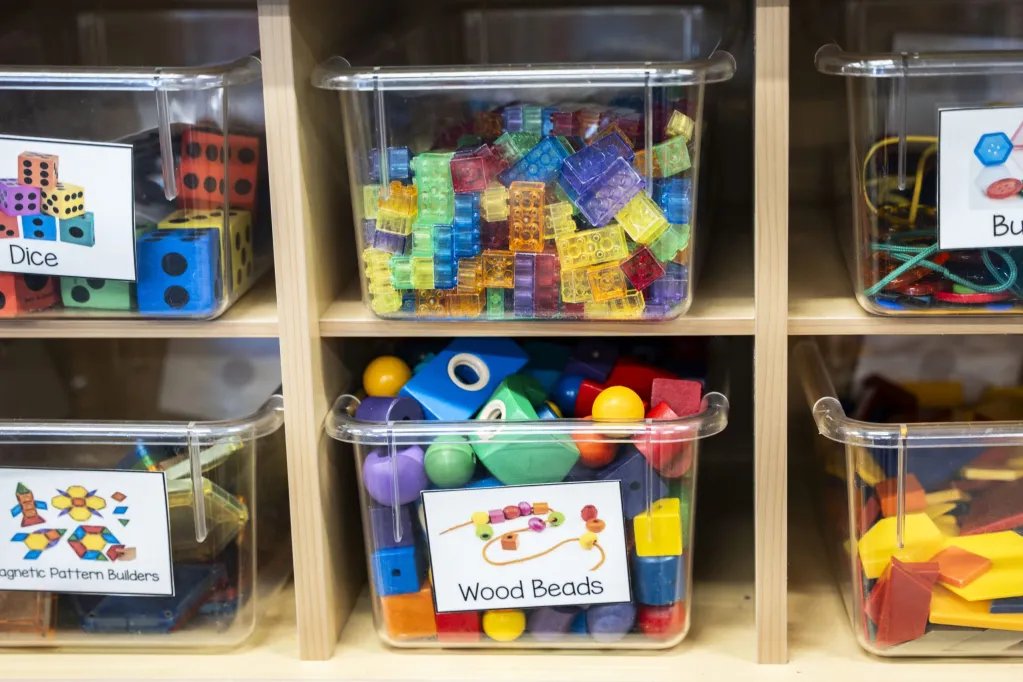

CORINTH, Miss. — Vaughn Dodd uses Magna-Tiles to build a rocket, carefully selecting different shapes for the nose cone and tail. This four-year-old Kindergarten student at Corinth Elementary School knows that a diamond shape is called a diamond. She knows that the sun is a circle.
Mastering translucent plastic shapes may not lead directly to future employment in Mississippi’s growing aerospace industry, but it’s not a bad launching pad for a number of careers involving math concepts.
Vaughn’s teacher, Kayla Wood, organizes a series of activities in the name of math, some with the whole class and others in small groups. Toys like Magna-Tiles, which support counting, sorting, and other skills, are available for independent play.
“There are no worksheets here,” Wood said. “We never do worksheets, even during literacy. We can form letters and numbers with Play-Doh. It’s very handy.”
Wood implements Building Blocks, the mathematical component of Early Mississippi curriculum for state-funded pre-K programs. Mississippi is the first state to mandate math curriculum for its preschool program, which currently serves about 8,700 children, a quarter of the state’s four-year-old population. The deployment of the program started in 2022 and is expected to be present in all state-funded preschools by August 2027.

Mississippi’s choice of a common preschool math curriculum serves several purposes, said Christina Weiland, a professor of education at the University of Michigan. The university’s Education Policy Initiative is helping Mississippi roll out the program.
As an example, coaches and teachers can focus on learning a program, Weiland said. It also ensures that preschool math goes beyond basic number recognition.
“What we know from research is that without an explicit math curriculum, preschools spend very little time on math,” Weiland said. “This is often a fairly neglected part of the curriculum, and it often remains very superficial, around basic counting activities. »
Mississippi’s efforts come at a time when many states are interested in early math learning. More than a dozen states passed laws requiring schools to assess students’ math knowledge in early grades and intervene with additional support if needed. Other states are placing mathematics teachers in elementary schools or have required changes to teacher preparation programs in an effort to strengthen new teachers’ knowledge of early mathematics instruction.
Related: Young children have unique needs and providing the right care can be a challenge. Our free early childhood education newsletter tracks issues.
Other fundamental math skills for young children include recognizing the number of items in a small set without counting them individually and understanding how to divide a number into two smaller ones.
Even learning forms, a mainstay of preschool classrooms, present an opportunity for math-focused language, Weiland said. A triangle, for example, not only has three sides: it has three straight sides and three angles. “It teaches kids the language of precision,” Weiland said.

The Mississippi Department of Education hopes programs like Building Blocks can help the state’s math performance match their reading levels. Mississippi has already gained attention for its successful efforts to improve literacy outcomes in the state – the so-called “Mississippi Miracle.”
Jill Dent, director of the Mississippi Department of Education’s Office of Early Childhood, prefers the “Mississippi Marathon.” When the preschool program once used by the state stopped working, she began looking for an alternative. A visit to Boston, which had accumulated winnings with his Focus on pre-kindergarten program, came at an opportune time for Dent.
“When I saw those classrooms, it was amazing,” Dent said. “It was what classrooms are supposed to look like. It reminded me of old-fashioned preschool. They had the curriculum, but it wasn’t a written curriculum. It matched the kids’ needs.”
In pre-kindergarten classrooms, teaching math doesn’t always look like teaching math. For example, during read aloud, Wood reads the picture book “The Seven Chinese Sisters” to her students. In addition to counting the seven sisters, students identify the many shapes and colors in the book.
Building Blocks, adapted from Focus on Pre-K, introduces children to one or two math concepts each week, provides daily math experiences and skill building, and integrates math into other parts of the curriculum like reading.
The book is part of the fourth and final week of “Family,” the first unit of the school year. “There’s a subtle mathematical component to Family,” Wood said. “It’s not like you sit them down and say, ‘We’re doing math now.’ It’s just that you’re introducing math concepts.
The Boston Public Schools Department of Early Childhood developed Focus on Pre-K to be free and open source, ready for adaptation in other parts of the country. Although the program itself cost Mississippi nothing, its statewide implementation cost nothing.
The state supports kindergarten educators with textbooks and training, but, according to Dent, the secret sauce is teacher coaching.
“Coaching is part of what has moved Mississippi forward,” Dent said. “It’s part of literacy. If you don’t support teachers after offering them professional training, they won’t apply it.” The state has 32 educators who focus specifically on early childhood education.
RELATED: State bets on parents to improve preschool math skills
Shira Kolnik Mattera, senior research associate at the social policy organization MDRC, agrees. MDRC is providing technical assistance to Mississippi as it rolls out its first math initiative.
“A lot of teachers turned to this world because they didn’t want to do math,” Mattera said. “And so a lot of the work that we’ve been helping states think about is, how do we engage people in implementing math?
That’s where coaches come in. Robin Brand is the regional early childhood coordinator for North Mississippi and a classroom coach. She travels from school to school, observing teacher-child interactions, developing lesson plans and setting learning goals. She shows teachers that counting furniture in a dollhouse, identifying shapes in a patterned dress, and drawing pictures together make math part of children’s everyday language and interaction.
Brand said a teacher warned her: “You can come into my room, but it won’t change anything I do. I’m going to do what I’m going to do anyway.” But she came back, Brand said, and now texts him and asks for suggestions and ideas.
That direct support made a difference for Stephanie Bullard, Wood’s pre-kindergarten colleague at Corinth Elementary. She had become familiar with the curriculum used by the state before adopting it.
“A lot of us were a little confused when we started Building Blocks, but we’re slowly getting back on track,” she said. Interactions with students were not how she had been trained.
Gentle persuasion from a trusted coach helped change her mindset, Bullard said, and she is now a convert.
“This method is more interactive,” she said. “Children choose their own direction and that’s how they learn.”
At Kossuth Elementary School, about 10 miles from Corinth Elementary School, Chassey Nelms’ pre-kindergarten students were playing a game that asked them to identify how many slices of pepperoni were on a toy pizza — without counting.
Nelms repeatedly asked the children not to give out the number, but it was a struggle for them in their eagerness. When she promised to steal a “delicate” pizza (zero pepperoni), a boy assured her that she could never cheat on him.
A call and response ritual followed. “We can do…” Nelms began.
“Difficult things!” » exclaimed the children.

Nelms said she developed this skill every day for three weeks as part of the foundational math skill of recognizing the number of small groups of items without counting them.
After a few rounds, Nelms changed things up, asking his class to pretend the pepperonis weren’t pepperonis but ducks in a pond. The children sang a counting song that they all knew.
When finished, Nelms announced that they had done such a good job that it was time to “give your brain a big smoocheroo!” » They all kissed each other’s palms and slapped each other on the top of the head.
Contact editor Christina A. Samuels at 212-678-3635 or samuels@hechingereport.org.
This story about preschool math was produced by The Hechinger reportan independent, nonprofit news organization focused on inequality and innovation in education. Subscribe to our early childhood newsletter.
The article Preschool math takes off in Mississippi appeared first in The Hechinger Report.